

FDA decisions are often presented as simple, binary events.
Approved means the stock rises. Rejected means it falls.
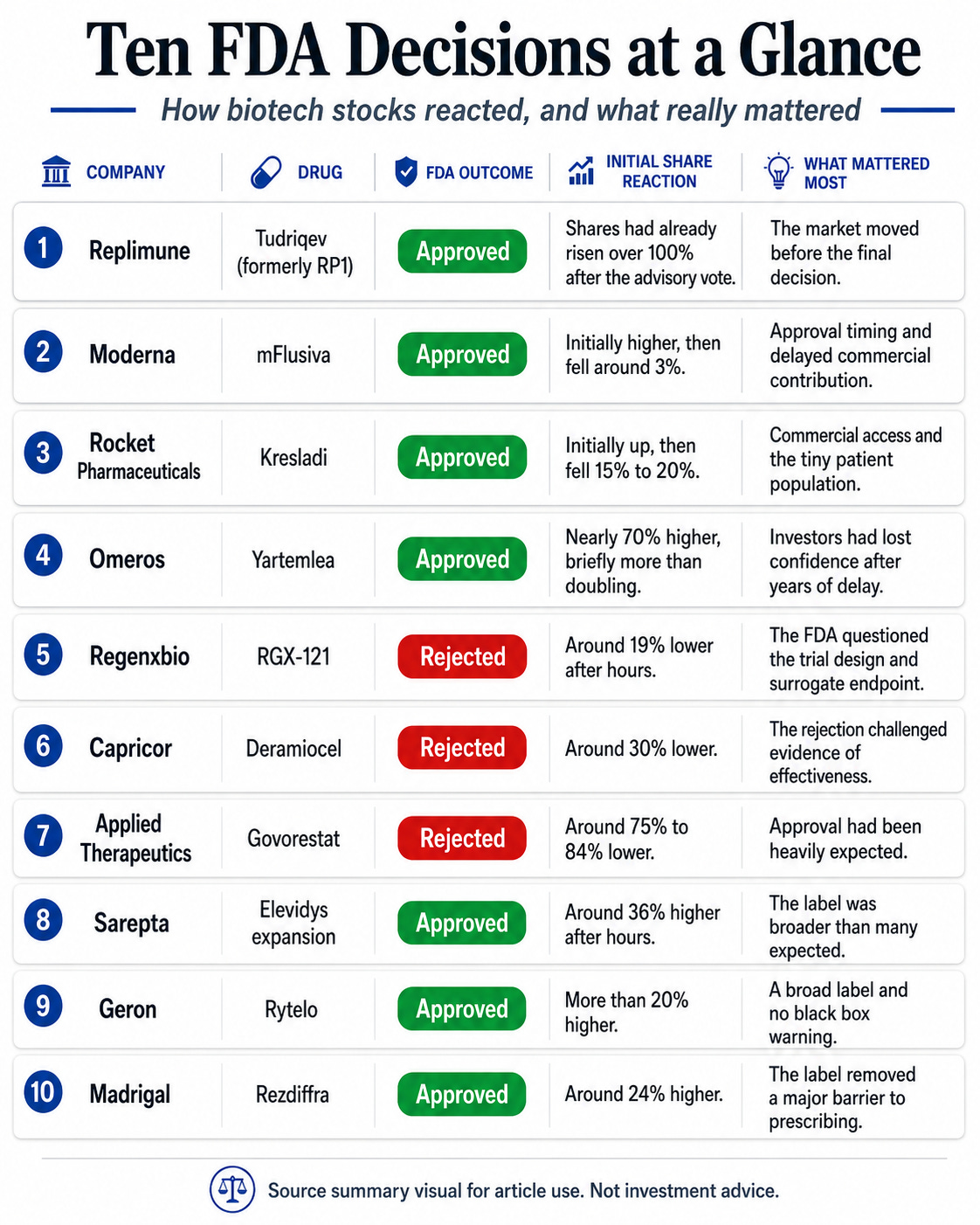
In practice, biotech rarely works that neatly. A company can receive approval and lose 20% of its value within hours. Another can win an approval that most investors already expected and still jump 25%. A rejection caused by a manufacturing problem may be recoverable, while a rejection questioning whether the drug works can destroy most of the investment case.
The FDA decision itself is only part of the equation. The market is also reacting to what it expected, the wording of the label, the reason for any rejection, the commercial opportunity and how much of the company’s value depended on that single drug.
A study covering thousands of pharmaceutical announcements found that negative events generally produce stronger market reactions than positive ones. It also found something familiar to experienced biotech investors: stocks sometimes fall after apparently positive news.
The following ten decisions from 2024 to 2026 show why.
The ten decisions at a glance
1. Replimune: sometimes the final FDA decision is not the main event
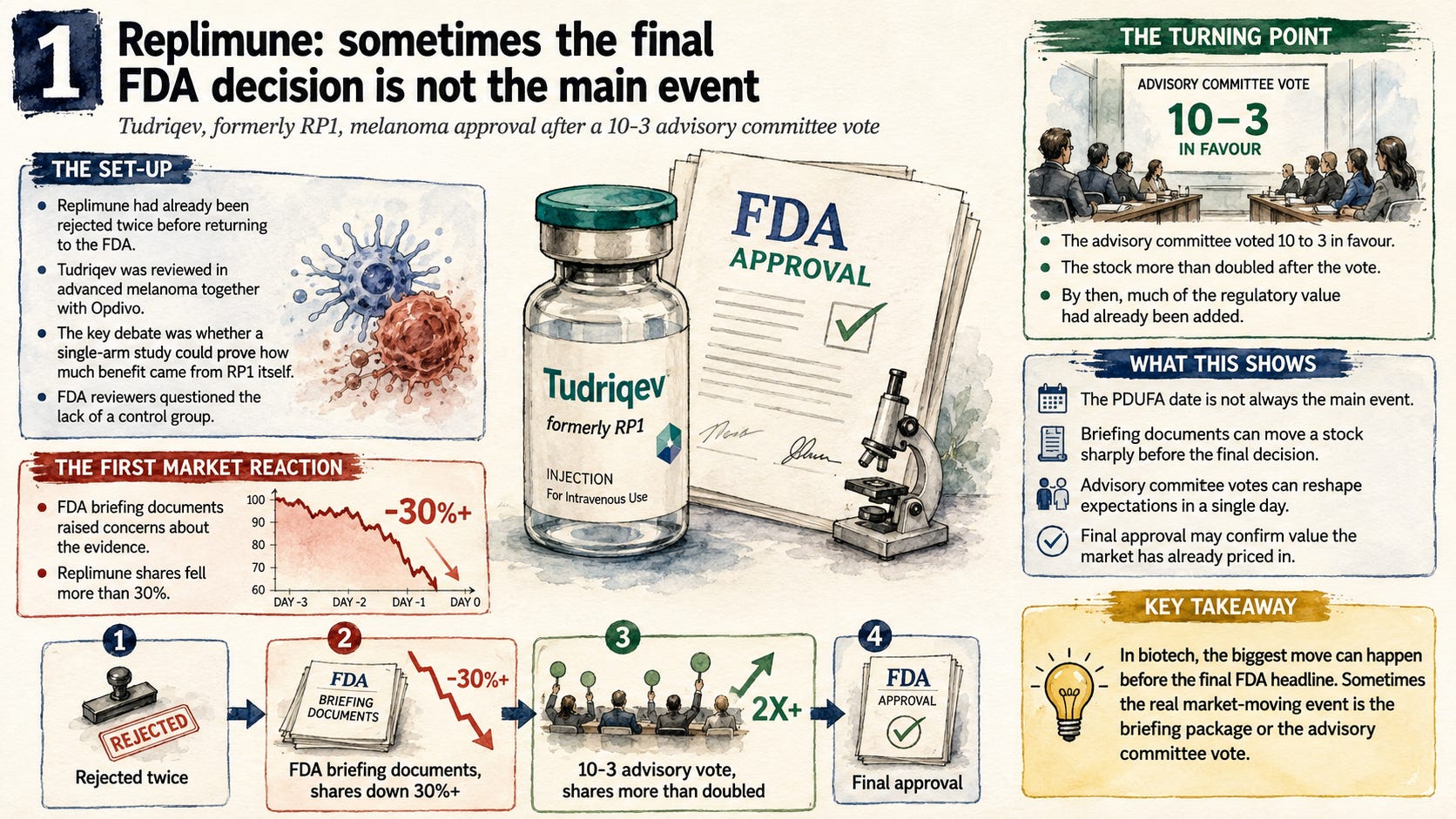
Replimune’s melanoma treatment, now called Tudriqev, had already been rejected twice before returning to the FDA in 2026.
The central problem was not whether the treatment produced any responses. It was whether a single-arm study could establish how much benefit came from RP1 itself when it was used alongside Bristol Myers Squibb’s Opdivo. FDA reviewers questioned the lack of a control group and produced a more conservative assessment of the response data.
Those concerns sent Replimune shares down by more than 30% when the FDA’s briefing documents appeared.
Two days later, an advisory committee voted 10 to 3 in favour of the evidence. The stock more than doubled. By the time the FDA formally approved the treatment, much of the regulatory value had already been added to the share price.
This is an important pattern. The PDUFA date may be circled on everyone’s calendar, but the decisive moment can arrive earlier through briefing documents, an advisory committee vote or updated FDA correspondence.
Anyone waiting for the final “approved” headline may find that the market has already moved.
2. Moderna: approval does not solve a timing problem
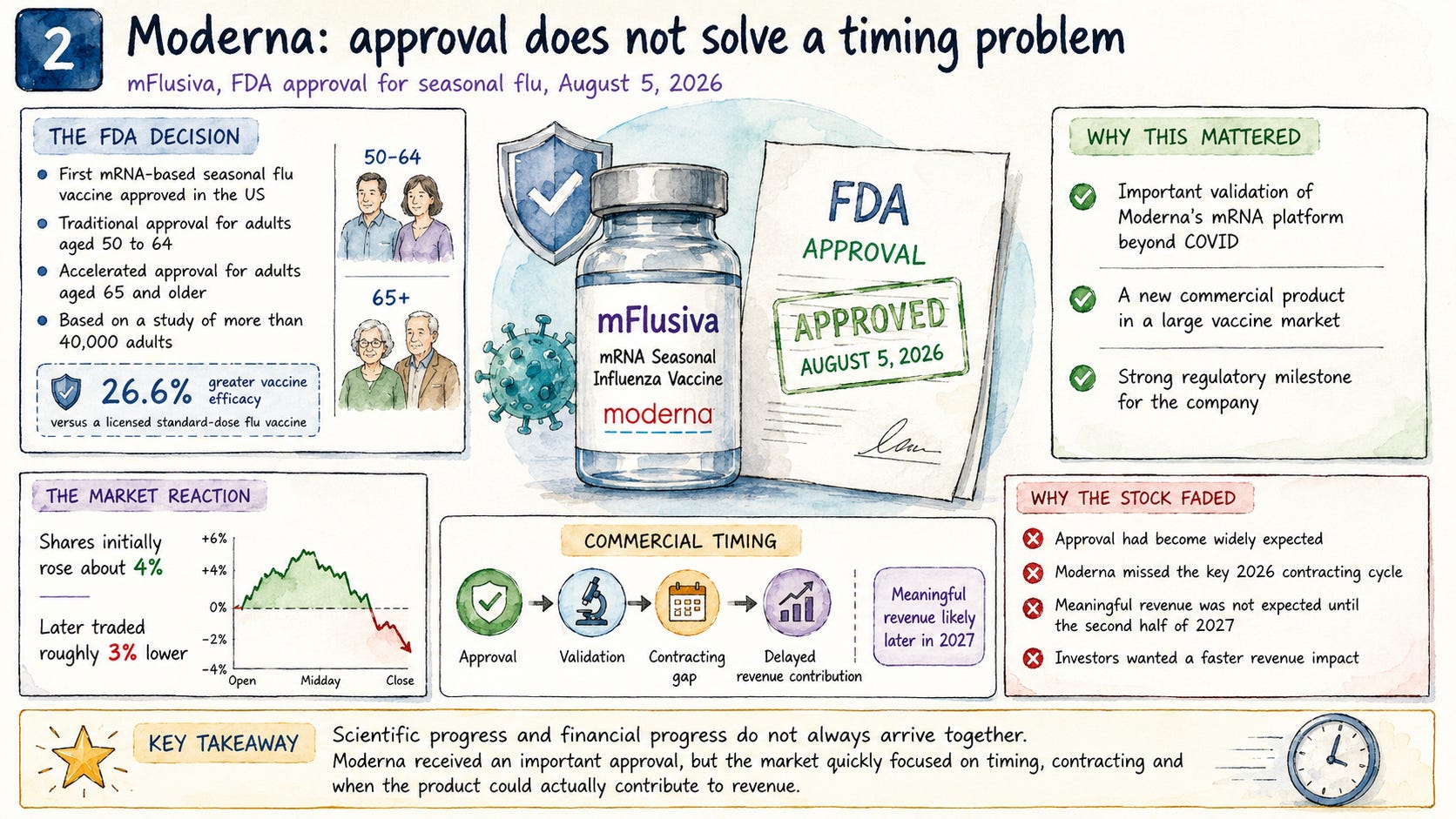
Moderna’s mFlusiva became the first mRNA-based seasonal flu vaccine approved in the United States. For adults aged 50 to 64, it received traditional approval. For those aged 65 and over, the FDA used accelerated approval based partly on immune-response data.
It was an important validation of Moderna’s technology outside COVID-19.
The stock initially rose by around 4% in premarket trading, but later slipped by roughly 3%. The reason was not that the approval lacked scientific significance. It was that investors had already started looking beyond the headline.
An advisory committee had voted unanimously in favour of the vaccine, making approval increasingly likely. Moderna had also missed important purchasing and contracting cycles, limiting the product’s near-term commercial contribution. Analysts were not expecting meaningful revenue until later in 2027.
The company received the approval investors wanted, but not an immediate solution to its revenue problem.
For larger biotech companies, the value of an FDA approval depends on how quickly the product can affect revenue, cash flow and the broader investment case. Scientific progress and financial progress do not always arrive together.
3. Rocket Pharmaceuticals: an approved drug can still be difficult to sell
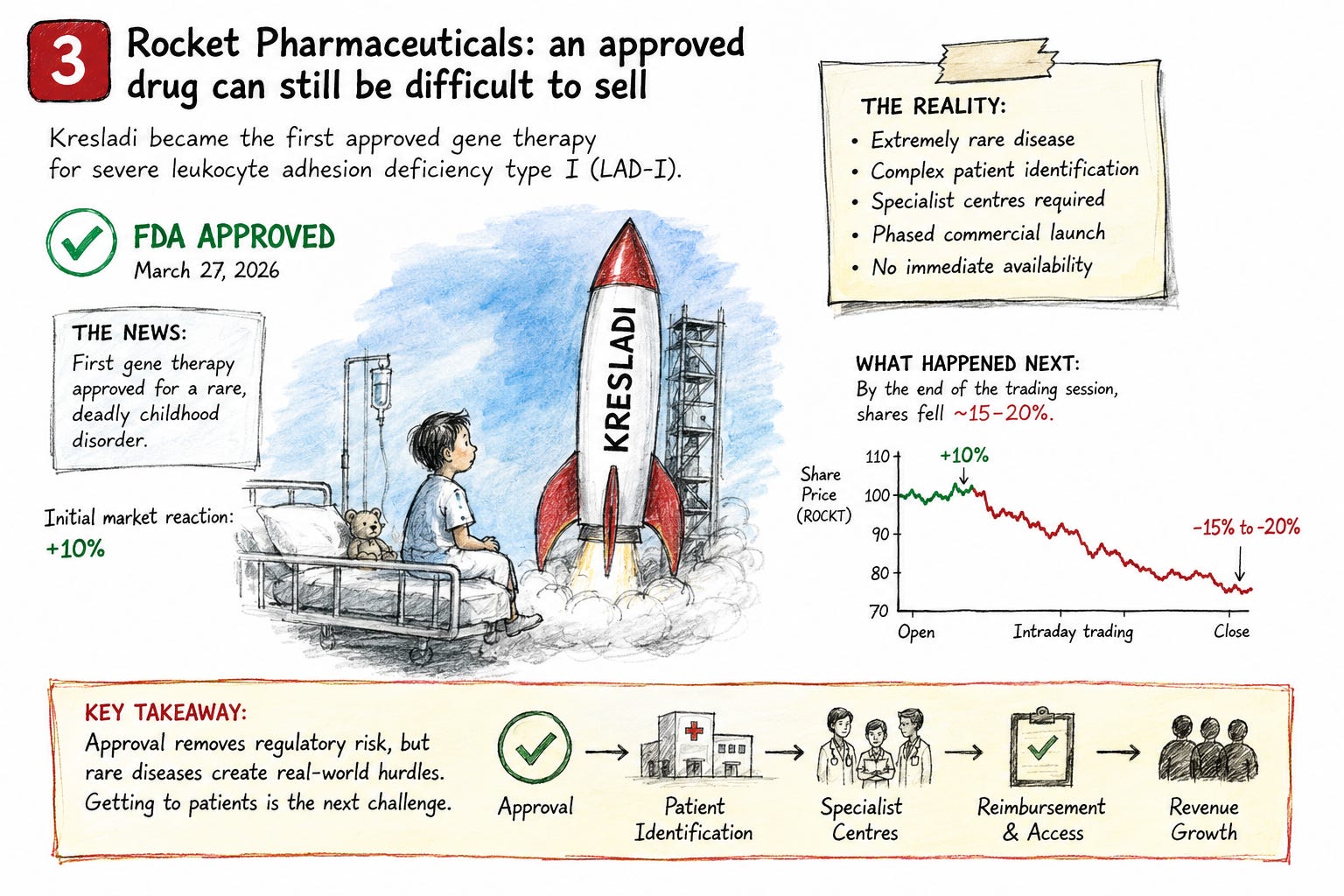
Rocket Pharmaceuticals received FDA approval for Kresladi, the first approved gene therapy for severe leukocyte adhesion deficiency type I.
The disease is devastating. Without effective treatment, many affected children die at a very young age. Kresladi therefore addressed a genuine unmet medical need and also earned Rocket a valuable priority review voucher.
Rocket shares initially rose by more than 10%. By later in the session, they were down approximately 15% to 20%.
Investors quickly shifted their attention from approval to delivery. Severe LAD-I is extremely rare. Patients must be identified, referred to specialist centres, prepared for gene therapy and supported through a complicated treatment process. Rocket planned a phased launch through a small number of centres, with commercial availability not beginning immediately.
Approval established that Kresladi could reach the market. It did not establish how quickly Rocket could find patients, secure reimbursement and convert the approval into meaningful revenue.
A small patient population can support a valuable rare-disease drug, particularly when pricing is high. It can also produce a slow and uneven launch. Approval removes regulatory risk, but it does not remove commercial friction.
4. Omeros: low expectations can make approval explosive
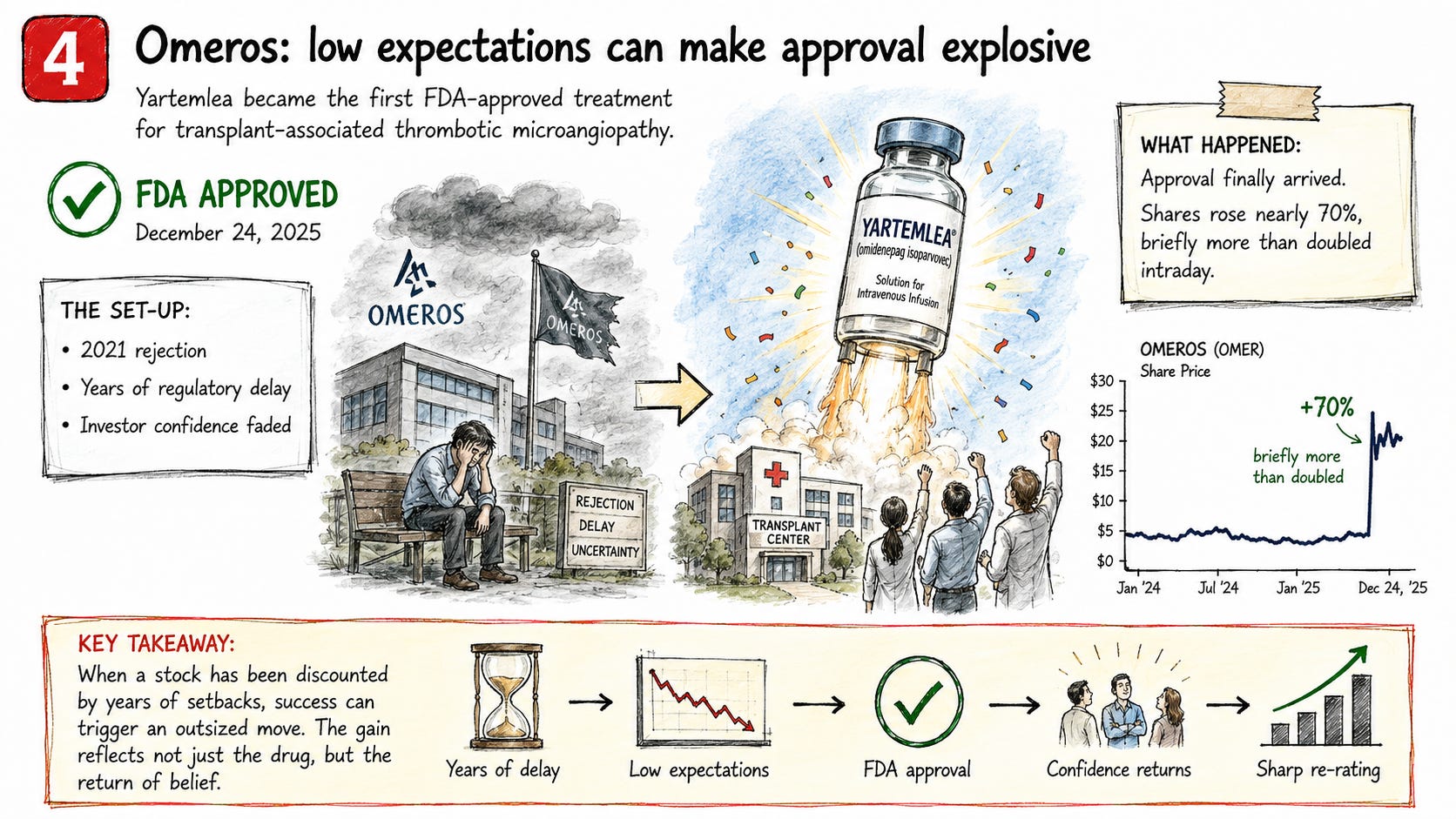
Omeros had spent years trying to secure approval for narsoplimab, eventually marketed as Yartemlea, for transplant-associated thrombotic microangiopathy.
The FDA initially rejected the application in 2021. The company continued discussions with the agency, provided additional analyses and remained committed to the programme, but investor confidence deteriorated. By late 2025, the drug had become a “show me” situation. The market wanted a decision, not another regulatory update.
When approval finally arrived, Omeros shares rose nearly 70%, having briefly more than doubled intraday.
The treatment became the first FDA-approved therapy for the condition, covering adults and children aged two and older. The approval also transformed Omeros from a company pursuing a disputed regulatory case into one with a commercial product.
This was not simply the market valuing a new drug. It was the market removing years of accumulated doubt.
Biotech stocks can become so discounted after repeated setbacks that eventual success produces a much larger move than the size of the immediate commercial opportunity might suggest. The share price is not just reflecting the drug. It is reflecting how many investors still believe the company can deliver anything at all.
